


WelcSteel, Storm, and Sovereignty: A History of the Royal Canadian Navy
Nations, like men, are often forged in war. But navies are forged in uncertainty — in the long shadow between sovereignty and sacrifice, between coastlines and commitment. For Canada, a country bounded by three oceans yet long tethered to British imperial policy, the birth of a national navy was both an act of identity and an instrument of independence. The Royal Canadian Navy (RCN), like the country it serves, has evolved in fits and starts — summoned in crisis, reshaped by conflict, and questioned in peacetime.
From its inception in 1910 to its role in the Cold War and 21st-century operations, the RCN has fought more than foreign adversaries. It has fought for relevance.
Before the Navy: Colonial Seas and Imperial Shadows
Canada’s early maritime defence was Britain’s responsibility. Before Confederation and well into the 19th century, the Royal Navy maintained North Atlantic and Pacific stations in Halifax and Esquimalt. As historian William Rawling notes, “Canada’s coasts were seen as British imperial highways — not national borders to be defended” (The Seabound Coast, 2010, p. 12). This dependency bred both protection and complacency.
By the early 20th century, with the rise of German naval power and growing imperial anxiety in London, Canada was urged to contribute to imperial naval defence. In 1909, amid the Dreadnought Crisis, British appeals for support ignited a domestic debate that split the nation along linguistic, political, and cultural lines.
The Naval Service Act and Its Discontents (1910–1914)
Prime Minister Sir Wilfrid Laurier’s solution was a compromise: a Canadian navy under national control, capable of assisting Britain when needed. The Naval Service Act of 1910 established the Naval Service of Canada, later granted the title “Royal” in 1911. Its initial fleet — the aging cruisers HMCS Rainbow and HMCS Niobe — was modest and largely symbolic.
Laurier’s policy pleased no one. Imperialists called it insufficient; Quebec nationalists, led by Henri Bourassa, saw it as subjugation to British wars. When Robert Borden’s Conservatives came to power in 1911, they tried (and failed) to replace it with the controversial Naval Aid Bill, proposing instead to fund dreadnoughts for the Royal Navy directly. As Marc Milner wrote, “Canada wanted a navy, but not the politics that came with one” (Canada’s Navy: The First Century, 2010, p. 34).
Baptism by Fire: The First World War (1914–1918)
At the outbreak of the First World War, the RCN was still embryonic — only 350 regular personnel and a handful of ships. While the Royal Navy protected Canada’s coasts, the RCN focused on coastal patrols, port defence, and anti-submarine operations in the western Atlantic.
One defining action came in 1918 when HMCS Rainbow escorted interned German vessels from Vancouver, and Canadian-manned trawlers and drifters conducted crucial, if unheralded, anti-submarine patrols. The war exposed Canada’s lack of maritime self-sufficiency but laid the groundwork for institutional survival.
Interwar Ambivalence and Institutional Drift (1919–1939)
The postwar period was unkind to navies — Canada’s most of all. With budget cuts, public indifference, and shifting defence priorities, the RCN shrank to near-invisibility. In 1923, the entire fleet consisted of two destroyers, one depot ship, and fewer than 400 personnel. Naval historian W.A.B. Douglas called the interwar RCN “a paper navy…floating on hope and nostalgia” (*RCN in Retrospect, 1982, p. 61).
Still, its leaders — notably Rear-Admirals Walter Hose and Percy Nelles — kept the flame alive. Naval reserves were strengthened, and training slowly improved. Canada entered the Second World War with a skeleton navy but a functional one.
The Second World War: From Minuscule to Monumental (1939–1945)
When war came in 1939, the RCN possessed only 13 vessels and 3,500 sailors. By 1945, it had grown into the third-largest navy in the world with over 400 commissioned ships and nearly 100,000 men and women in uniform.
The RCN’s most critical role was in the Battle of the Atlantic, escorting Allied convoys through waters thick with German U-boats. Canadian-built corvettes and frigates, crude but effective, became the workhorses of convoy protection. Historian Roger Sarty observed that “no country built so many ships, trained so many sailors, and fought so hard on the Atlantic without having done so before” (The Battle of the Atlantic: Canada’s War at Sea, 2013, p. 88).
Canadian MTBs and destroyers also fought in the English Channel, supported the D-Day landings, and served in the Pacific against Japan. The RCN emerged from the war seasoned, respected — and uncertain about what came next.
Postwar Downsizing and the Cold War Realignment (1945–1968)
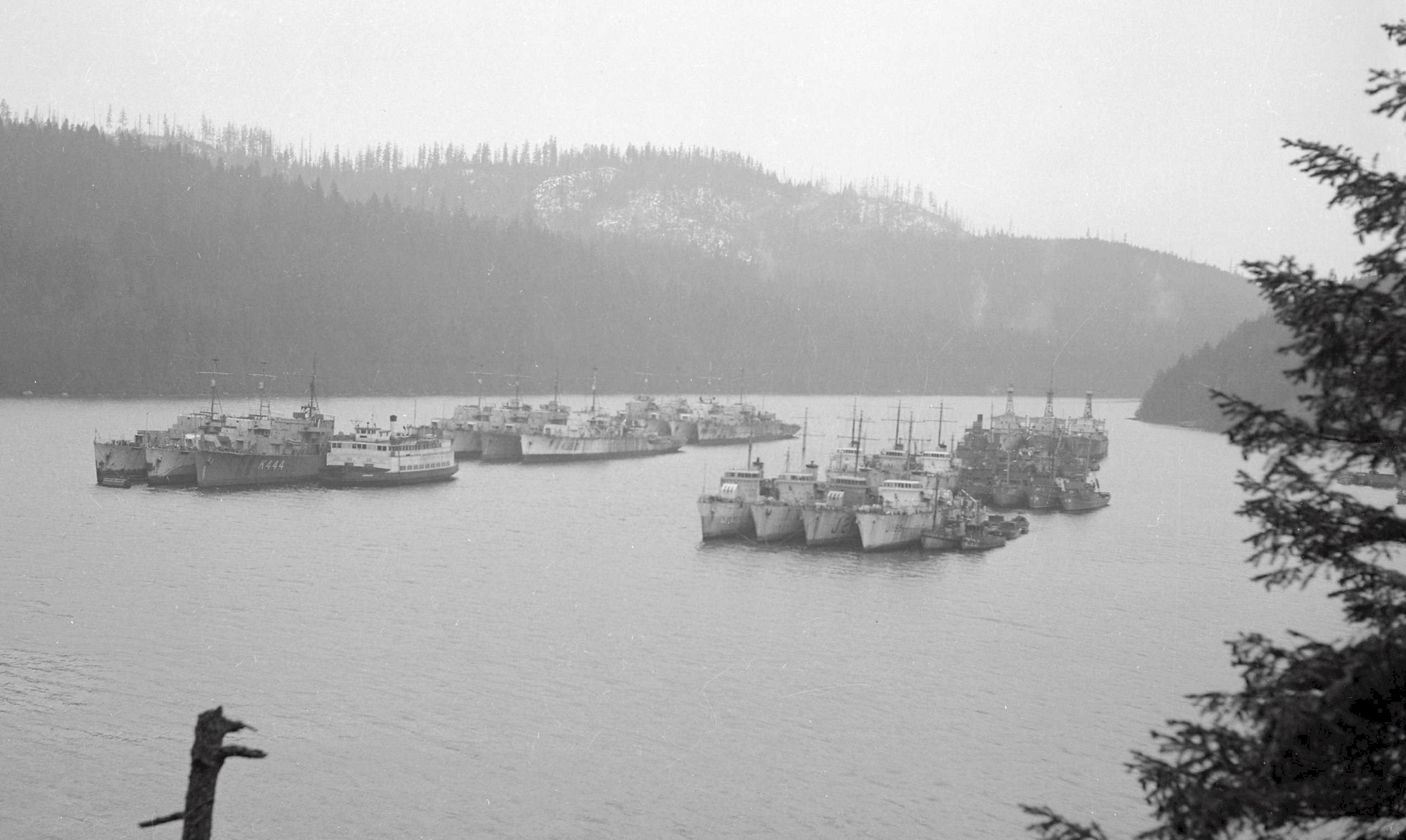
Demobilization hit hard. Within months of V-E Day, the RCN was reduced by more than 70 percent. Most wartime vessels were scrapped or sold. Yet in a world now split by the Iron Curtain, a new mission soon emerged.
The RCN became a key player in NATO’s maritime defences, focusing on anti-submarine warfare in the North Atlantic. New ships — like the St. Laurent-class destroyers and aircraft-carrying destroyers — reflected Canada’s niche as a cold-water ASW specialist. Canada’s navy was leaner but better trained, technologically advanced, and deeply integrated with Western alliances.
Controversies, Unification, and Identity Crisis (1968–1990)
In 1968, the unthinkable happened: the RCN was abolished as a separate service under the unification of Canada’s Armed Forces. Naval uniforms, ranks, and traditions were scrapped. This “green-washing,” as veterans called it, drew intense criticism. “You can paint a destroyer green,” one sailor quipped, “but it still sails on saltwater.”
Despite controversy, the navy adapted, contributing to Cold War missions, fisheries patrols, and peacekeeping. But morale and identity suffered.
Modern Renaissance: The RCN in the 21st Century
In recent decades, the RCN has been quietly reborn. Its involvement in Gulf War operations (1990–91), counter-terrorism patrols, Arctic sovereignty exercises, and humanitarian missions has reaffirmed its versatility.
The 2000s brought HMCS Harry DeWolf and the Arctic and Offshore Patrol Ship program, reflecting a renewed focus on northern security. Meanwhile, the Halifax-class frigates, equipped with cutting-edge ASW and air defence systems, remain the backbone of Canadian naval power.
As Marc Milner notes, “Today’s navy is lean, professional, and increasingly joint in doctrine. It carries less steel, but more consequence” (Canada’s Navy, p. 211).
Historiography and Reflections
The study of the RCN’s history has matured alongside the service itself. Early accounts — largely official and triumphalist — have given way to critical, deeply contextualized scholarship. Works like Douglas’s The Creation of a National Navy*, Sarty’s Canada and the Battle of the Atlantic, and Milner’s The Sea Is at Our Gates explore not just operations, but the political, social, and institutional dynamics of naval life.
Naval historiography now grapples with questions of civil-military relations, regional identity, and maritime strategy in a globalized era.
Conclusion: A Nation on Saltwater
The Royal Canadian Navy has never been the largest, nor the flashiest. But in every chapter of Canada’s story — from imperial colony to Cold War sentinel to 21st-century peacekeeper — it has been there, sometimes overlooked, always essential.
It remains a navy shaped by paradox: created to serve an empire, now defending a sovereign Arctic; once torn by unification, now a model of joint capability; once written off, now sailing into relevance.
Select References
Gimblett, R.H. (2009). The Naval Service of Canada, 1910–2010: The Centennial Story. Dundurn Press.ome to RCN History.
Milner, M. (2010). Canada’s Navy: The First Century. University of Toronto Press.
Douglas, W.A.B. (1982). RCN in Retrospect, 1910–1968. UBC Press.
Rawling, W.G.P. (2010). The Seabound Coast: Official History of the Royal Canadian Navy, 1867–1939. Dundurn.
Sarty, R. (2013). The Battle of the Atlantic: Canada’s War at Sea. Allen Lane.
Johnston, W., Rawling, W.G.P., Gimblett, R.H., MacFarlane, J. (2010). The Seabound Coast: Volume I. Dundurn.


Hi, this is a comment.
To get started with moderating, editing, and deleting comments, please visit the Comments screen in the dashboard.
Commenter avatars come from Gravatar.