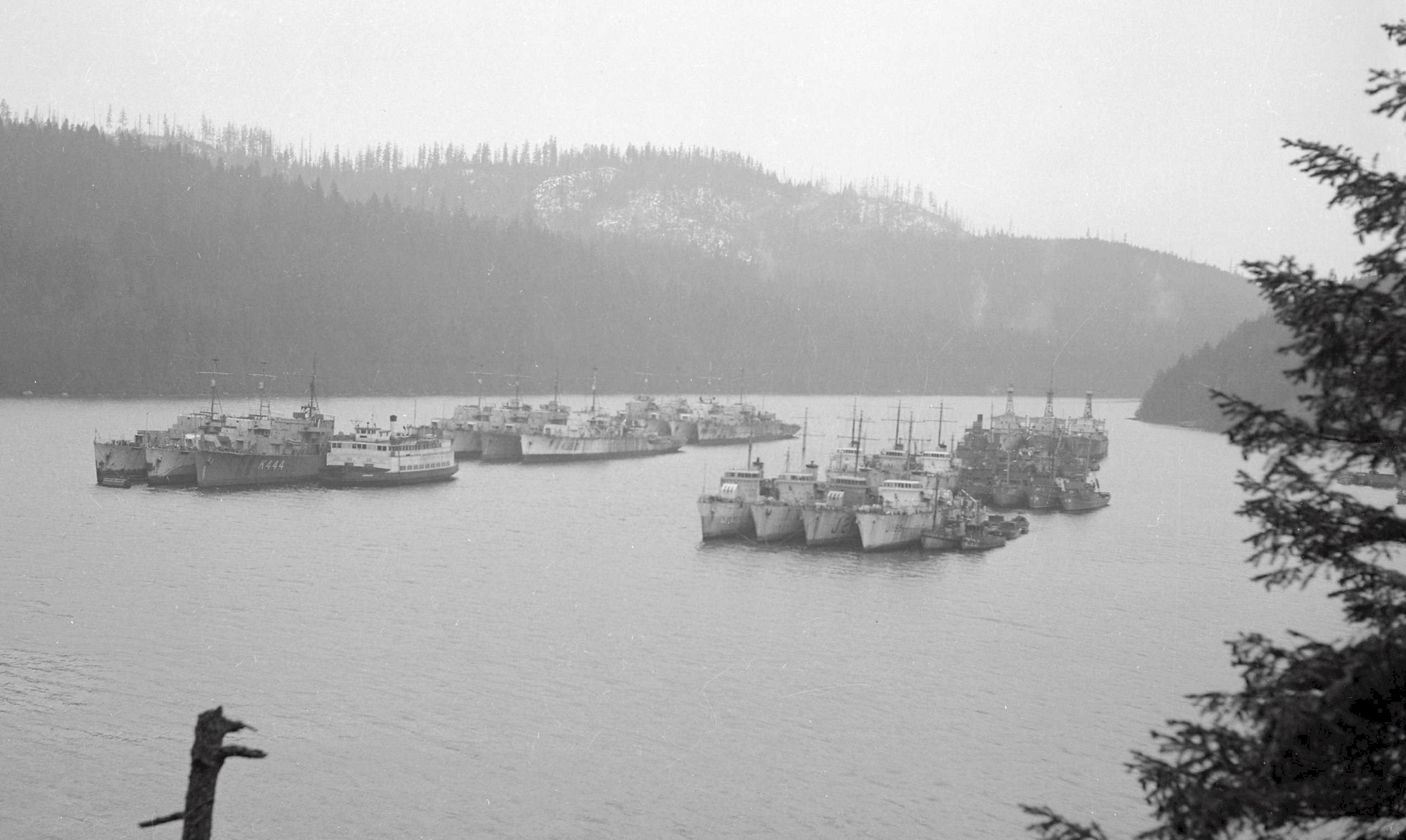
The Allied Shipyard Expansion of the Second World War
By the end of 1939, war had once again swept across Europe like a firestorm, and the oceans became its dark corridors. While the Wehrmacht blitzed its way across borders and the Luftwaffe blackened skies over London, another, quieter battle began to take shape in the shipyards and steel mills of the Allies. It was a war not of immediate glory but of sustained endurance — a logistical marathon that would test the industrial sinews of nations.
At the heart of this vast undertaking was a simple, unyielding truth: wars are won not only by strategy, but by supply. And the sea — both its protection and its conquest — demanded ships. Thousands of them.
A Naval Awakening: The Demand for Ships
The outbreak of war in September 1939 found the Allies woefully unprepared in terms of merchant and naval tonnage. Germany’s U-boat fleet, though modest in number, proved ferociously effective. The Royal Navy had been hollowed by interwar austerity. Canada’s navy, the Royal Canadian Navy (RCN), mustered a mere six destroyers and five minesweepers, a speck on the chart compared to the task ahead.
“The fundamental weapon of the Allies,” writes historian Paul Kennedy in Engineers of Victory, “was industrial mobilization.” The Germans had torpedoes; the Allies would answer with tonnage.
The Expansion Begins: Canada’s Maritime Rebirth
Canada, long reliant on British-built warships, rapidly transformed its waterfronts into bastions of war production. Between 1940 and 1945, Canadian shipyards produced over 400 warships and 3,000 smaller vessels, including corvettes, frigates, minesweepers, and landing craft. As M.A. Hennessy wrote in The Rise and Fall of a Canadian Maritime Policy, Canada’s shipyards “ranked among the country’s ten largest employers during the war, equalling the scale of aviation and armaments industries.”
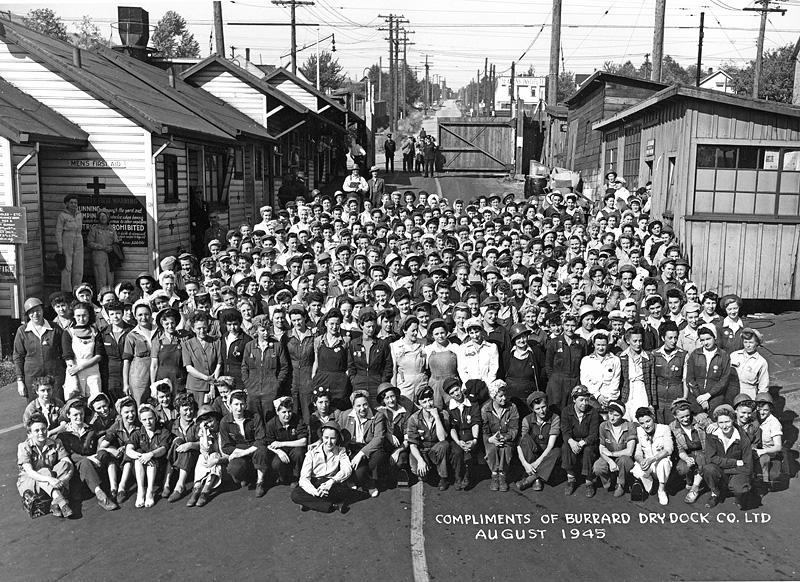
This was no mere support act. It was transformation by hammer and torch.
Key Canadian shipyards included:
- Burrard Dry Dock (North Vancouver, B.C.)
Produced 109 vessels including corvettes, frigates, and auxiliaries. Employed over 14,000 workers by 1943. - Halifax Shipyards (Nova Scotia)
A strategic location for Atlantic operations. Built minesweepers, corvettes, and merchant ships. Peaked at 12,000 employees. - Canadian Vickers (Montreal, QC)
Among Canada’s most advanced yards; built 36 Bangor-class minesweepers and other naval auxiliaries. - West Coast Shipbuilders Ltd. (Vancouver)
Created in wartime, it built Park-class merchant ships and 15 minesweepers.
As Craig Madsen notes in Labour/Le Travail, these workers “built a ship every 30 days by 1943 — a record of efficiency rivalling any yard in North America.”
The Royal Canadian Navy’s signature contribution, however, came in the form of the Flower-class corvette — small, rugged escort ships that served in the grisly Atlantic convoy battles. Canada built 122 of these, nearly half of all corvettes deployed by the Allies.
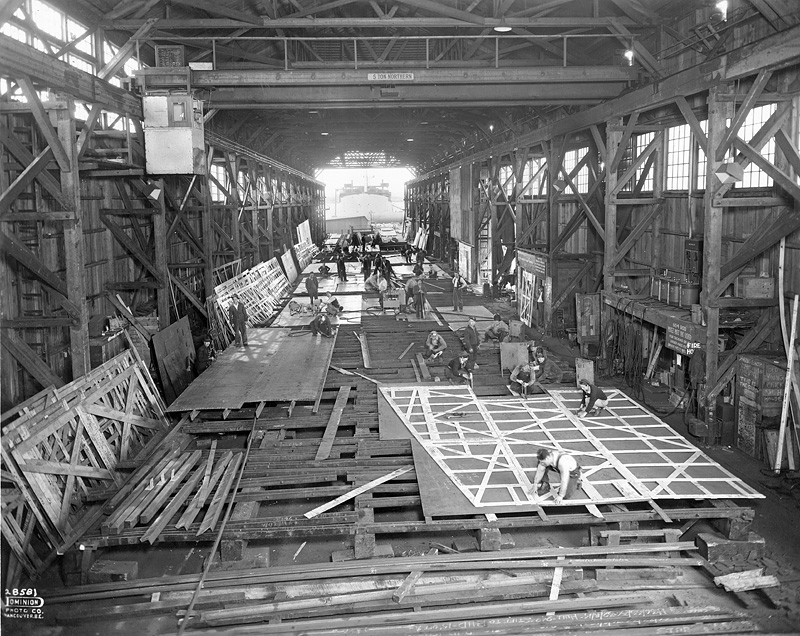
British Resolve: Shipyards Under Fire
Across the Atlantic, British shipyards — particularly in Clydebank, Barrow-in-Furness, and Belfast — bore the brunt of early Axis air raids. Yet they endured and delivered. Harland and Wolff, builders of the Titanic, now churned out Town-class light cruisers and River-class frigates. By 1945, Britain had constructed:
- 132 destroyers
- 58 cruisers
- 6 fleet carriers
- 1 battleship (HMS Vanguard)
British yards, constrained by proximity to German bombers, nonetheless employed nearly 1.7 million workers across all naval and merchant yards by war’s end. As military historian Nicholas Robins notes in Wartime Standard Ships, “Each ship launched was an act of defiance.”
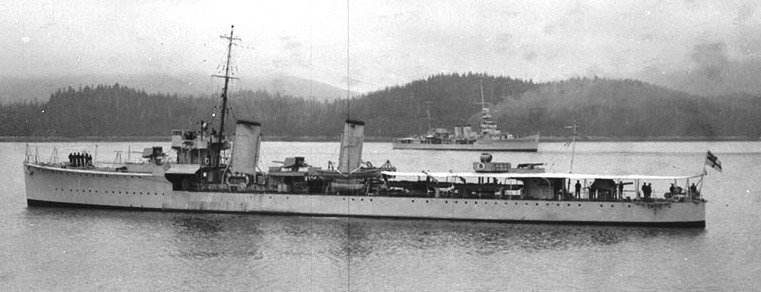
The Colossus Awakens: U.S. Industrial Might
But it was the United States, awakened after Pearl Harbor, that would become the veritable arsenal of democracy. Under the direction of the Maritime Commission and Navy Bureau of Ships, the U.S. expanded or created 60 shipyards, with giants like Bethlehem Steel (Massachusetts), Newport News (Virginia), and Kaiser Shipyards (California and Oregon) leading the charge.
From 1941 to 1945, the United States built:
- 1,200 Liberty Ships
- 531 Victory Ships
- 349 destroyers
- 122 escort carriers
- 10 battleships
- 18 fleet aircraft carriers
At its peak, the U.S. shipbuilding industry employed over 1.8 million men and women, many of whom were Rosie the Riveters, welding hulls under clouds of red-hot slag.
Historian Timothy Heinrich, in Warship Builders, notes: “It wasn’t just steel and rivets. It was a national will, pressed into form and sent to sea.”
Deployment and Strategic Reach
The output of these shipyards enabled the Allies to:
- Escort thousands of merchant convoys across the Atlantic, turning the tide in the Battle of the Atlantic.
- Supply and protect amphibious operations from North Africa (Operation Torch) to Normandy (D-Day) and the Pacific islands.
- Sustain global logistics, from Arctic convoys to Murmansk to Pacific invasions of Saipan and Okinawa.
Canadian-built ships were deployed primarily in North Atlantic, English Channel, and Western Approaches, where they battled German U-boats in harsh seas. Flower-class corvettes like HMCS Sackville, which still survives today as a floating museum, became “the shepherds of the storm,” as naval poet Earle Birney wrote.
Legacy of Steel
The Allied shipbuilding expansion of WWII was one of the largest industrial feats in human history. It was, in the words of naval historian Marc Milner, “a miracle of organization, political will, and raw human effort.”
By war’s end, Canada had grown from a minor maritime power to the third-largest navy in the world by number of vessels — most of them built in her own shipyards. Britain survived a siege of sea lanes with steel birthed under fire. The United States overwhelmed Axis production with sheer volume.
These shipyards — noisy, crowded, dangerous places — were the forges of freedom. They launched hulls that carried men and machines across oceans, bore the wounded home, and delivered the goods that would break the Reich and sink the Rising Sun.
Their ghosts linger in the rivets of old hulls, the piers of Halifax, and the rusting slipways of Vancouver. And their story, like the ships they built, deserves to sail on.
Select References
- Hennessy, M.A. (1999). The Rise and Fall of a Canadian Maritime Policy, 1939–1965. Library and Archives Canada. Link
- Madsen, C. (2010). “Organizing a Wartime Shipyard.” Labour/Le Travail, 65, 73–102. PDF
- Kennedy, P. (2013). Engineers of Victory. Random House.
- Milner, M. (2010). Canada’s Navy: The First Century. University of Toronto Press.
- Heinrich, T. (2020). Warship Builders: An Industrial History of U.S. Naval Shipbuilding, 1922–1945. Naval Institute Press.
- Robins, N. (2017). Wartime Standard Ships. Pen & Sword Maritime.
- Weir, G.E. (1994). “A Truly Allied Undertaking.” Naval Engineers Journal, 106(4), 89–104.