


The Royal Canadian Navy’s Great Postwar Unravelling, 1945–1947
In the dying months of the Second World War, as victory loomed on distant horizons and the smoke of battle thinned across the seas, Canada emerged as something it had never been before: a naval power.
With a fleet of over 400 warships and nearly 100,000 personnel, the Royal Canadian Navy stood as the third-largest navy in the world, behind only the United States and Great Britain. It was a staggering transformation for a country that in 1939 had mustered a mere 13 ships and fewer than 3,500 sailors. By 1945, the RCN had escorted over 25,000 merchant vessels across the U-boat-infested Atlantic, sunk or captured more than 50 enemy submarines, and served in operations from Normandy to Okinawa.
But what follows a war built on urgency and expansion is often a peace haunted by uncertainty and contraction.
A Navy Forged in Battle
The RCN’s expansion during the war was not merely quantitative. It developed a professional corps of officers, robust coastal commands, and a strong tradition of anti-submarine warfare (ASW). According to naval historian Marc Milner, “The wartime RCN was not simply a force of scale, but of skill. It earned its credentials in blood and brine” (Canada’s Navy: The First Century, 2010, p. 164).
Its composition in May 1945 included:
- 10 Tribal-class and River-class destroyers
- 70+ corvettes (mostly Flower-class)
- 60+ frigates (primarily River-class)
- 8 Algerine-class minesweepers
- Motor torpedo boats, minesweepers, landing craft, and auxiliary vessels
In total, 434 commissioned vessels operated under the RCN banner during the war, not including hundreds more in reserve or under construction.
Postwar Ambition: A Fleet to Keep the Peace
Victory brought not only pride but also a strategic question: What now?
Naval leadership, notably Vice-Admiral Percy W. Nelles and later Rear-Admiral H.G. DeWolf, envisioned a permanent peacetime fleet that would maintain Canada’s newfound maritime stature. According to W.G.D. Lund’s seminal study, The Rise and Fall of the Royal Canadian Navy, 1945–1964, senior leaders pushed for “a capable and mobile blue-water navy” to serve with NATO and the United Nations, defend North Atlantic sea lanes, and safeguard Arctic sovereignty (Lund, 1999, p. 42).
The postwar planning staff even proposed a fleet including cruisers, fleet carriers, and destroyer escorts, designed to integrate with British and American task forces in a new age of international tension.
As Rear-Admiral Rollo Mainguy warned in 1946, “We must not let the greatest navy Canada has ever known sink beneath us without a vision for what should remain” (quoted in Hennessy, Canadian Defence Policy and the Navy, 1999, p. 67).
From Mobilization to Demobilization
But the tide of public sentiment, economic reality, and political fatigue was stronger than the Admiralty’s ambition.
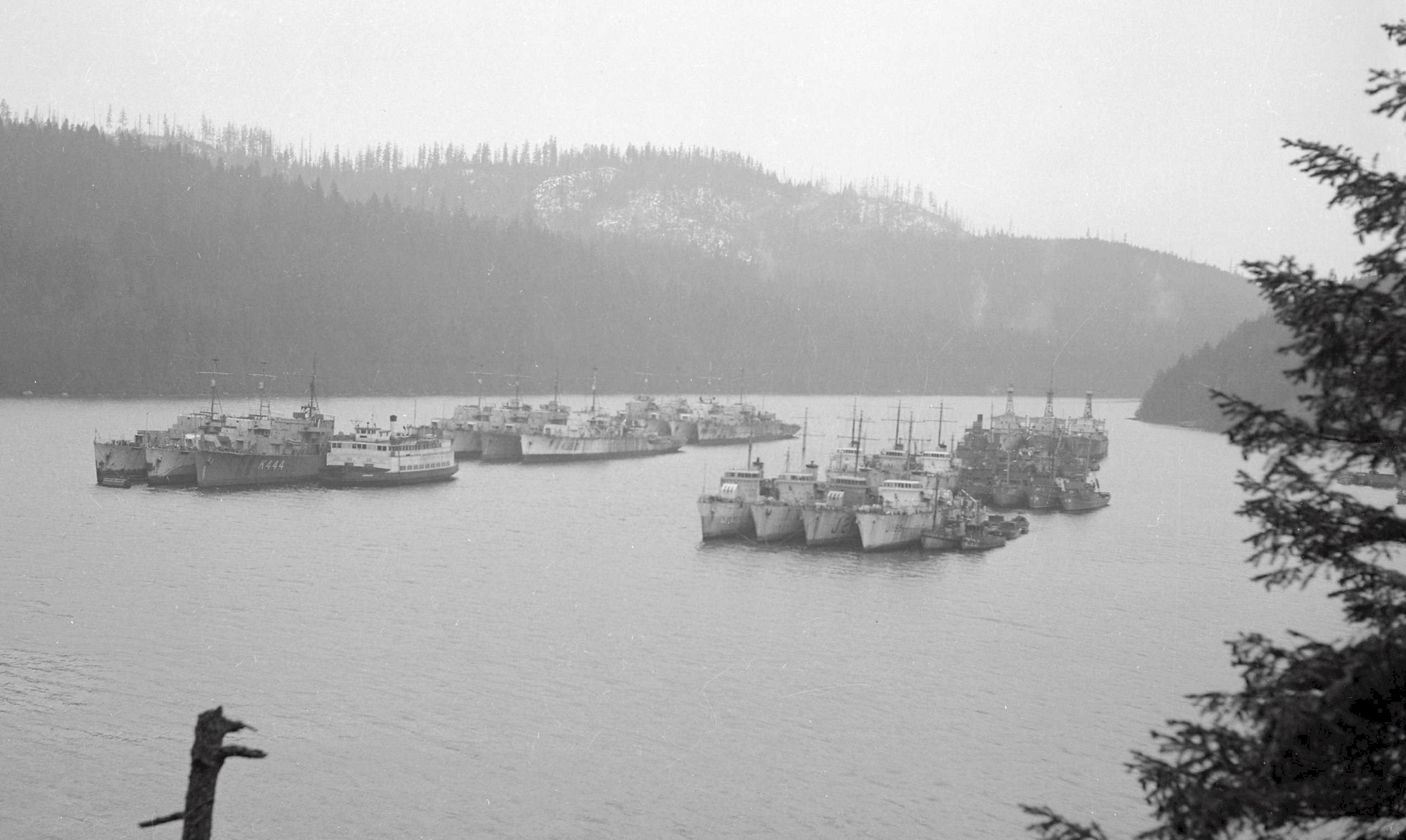
Demobilization began within weeks of V-E Day. By the end of 1945, over 60% of RCN personnel had been released, and entire flotillas were mothballed, sold off, or scrapped. Ships were decommissioned at a staggering rate:
- Most of the corvettes were deemed unfit for postwar service and either sold for scrap or converted to merchant use.
- Frigates were laid up in reserve fleets across Halifax and Esquimalt.
- The light cruisers HMCS Uganda and Ontario — envisioned as symbols of a global Canadian Navy — were decommissioned by the end of 1947.
- Dozens of vessels were sold to foreign governments, including France, Norway, and Turkey.
The RCN shrank from 95,000 sailors in 1945 to under 10,000 by 1947, the largest single-year naval reduction in Canadian history (Gimblett, The Northern Mariner, 1999, p. 26).
What the Allies built in five years, peacetime dissolved in two.
The New Mission: Cold Waters, Quiet Resolve
By 1947, global tensions had begun to shift. The Soviet Union emerged as a looming adversary, and the Atlantic once more grew restless. In this new reality, the Canadian government began to reconsider the role of its navy — not as a post-imperial afterthought, but as a northern partner in the emerging Cold War alliance system.
The 1947 Naval Staff Paper, drafted by senior officers, set forth a modest but strategic proposal: a navy designed to operate in NATO task groups, focused on ASW, maritime patrol, and limited expeditionary capability. The new mission was defensive, not imperial — a navy of deterrence and diplomacy, not conquest.
Fleet priorities shifted toward:
- Modern destroyers and escort carriers adapted for ASW roles.
- Air-sea integration with the introduction of aircraft-carrying destroyers in the 1950s.
- A continued focus on training, professionalism, and readiness over numerical supremacy.
As historian Michael Whitby observed, “The RCN did not vanish after 1945; it turned silently to face the next war — one of shadows, submarines, and uneasy peace” (Cold War Naval Policy and Canadian Maritime Strategy, 2005, p. 51).
Legacy and Reflection
The transformation of the Royal Canadian Navy from 1945 to 1947 is a story of paradox. A navy that had risen to the world stage was pulled back by economic constraint, political indifference, and postwar exhaustion. Yet within the bones of the dismantled wartime fleet, a professional, modern maritime force quietly took shape.
Rear-Admiral H.G. DeWolf, reflecting years later, put it succinctly: “We built the largest navy Canada had ever seen — and took it apart. But we kept the soul.”
Select References
- Lund, W.G.D. (1999). The Rise and Fall of the Royal Canadian Navy, 1945–1964. University of Victoria. Link to full thesis
- Milner, M. (2010). Canada’s Navy: The First Century. University of Toronto Press.
- Hennessy, M.A. (1999). Canadian Defence Policy and the Navy: A Reassessment, 1945–1965. Library and Archives Canada.
- Gimblett, R.H. (1999). “Too Many Chiefs and Not Enough Seamen.” The Northern Mariner, 9(2), pp. 19–32. PDF
- Whitby, M. (2005). “Cold War Naval Policy and Canadian Maritime Strategy.” Canadian Military History, 14(3), pp. 48–60.


